29 May 2013

[we were chosen by the northerly]

we were chosen by the northerly
the reindeer
the fish
the birds
-----chose

and we
-----gained spring's singular sun
the tales of the blue nights

-Nils-Aslak Valkeapää, 1984

24 May 2013

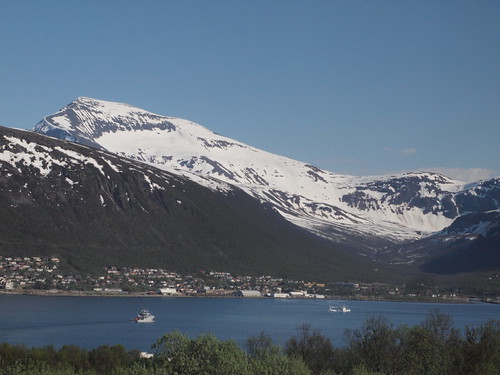
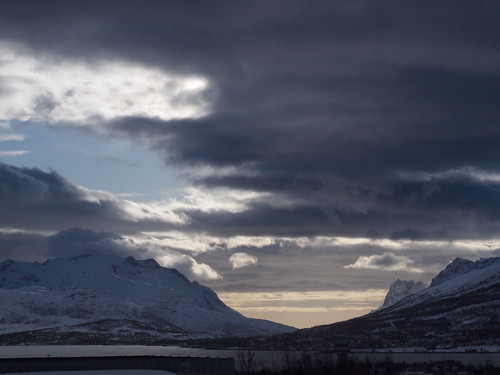
We seem to have skipped spring. I don't know if it's the constant sunlight that accelerates the season shift or some global warming thing, but after a long winter spring has been foreshortened as the temperatures leap, the snow retreats at an alarming rate, and Tromsøya (the island Tromsø is on) turns green. Even the snow on the mountains is vanishing, and and every day exposes expanding patches of dark earth and stone. And in the city, fleets of toddlers in neon vests go on field trips. Elderly women have taken up sunbathing.

Tromsø is pretty close to the roof of the world, and up here the year starts to feel like a strange wheel. There's something about it--when I got here in January the sun hardly existed, and now it's like that old country song: that lucky old sun just rolls around heaven all day. The middle of the night could be the middle of the day, and maybe it is: birds call, I sit up at my desk because I've lost track of time, or wake with a start to check the clock and discover it's 3 am, despite the clean light and blue skies. I miss the night, a little bit. There's something I love about summer nights--"show a little faith, there's magic in the night," to quote Springsteen--and up here summer is defined by the absence of night. Which is, on the other hand, freeing in a different way from the summer nights I'm used to: I can leave the house at night to go out walking and not worry about the encroachment of darkness. It makes time, and the day, feel infinite. Everything blurs together, and the sun rolls across the sky in a narrowing gyre.

22 May 2013

Kef 21

First there was the earth in my mouth. It was there like a running stream, the July fever sweating the delirium of August, and the green buckling under the sun. The taste of sick dust ran in the currents of saliva which I heaved up and tried to picture when all the people would curse their own stinking guts and die. No. I am not wishing that everyone should die. Nor am I wishing that everyone should be still. Only I am squeezing out the steam in me.

-Henry Dumas

15 May 2013

Breakage

I go down to the edge of the sea.
How everything shines in the morning light!
The cup of the whelk,
the broken cupboard of the clam,
the opened, blue mussels,
moon snails, pale pink and barnacle scarred--
and nothing at all whole or shut, but tattered, split,
dropped by the gulls onto the gray rocks and all the
--moisture gone.
It's like a schoolhouse
of little words,
thousands of words.
First you figure out what each one means by itself,
the jingle, the periwinkle, the scallop
--full of moonlight.

Then you begin, slowly, to read the whole story.

-Mary Oliver, 2003

It seems like a million years ago that I started Wednesday poem day, although no accurate calendar would give you that number. An accurate calendar would say that I started Wednesday poem day a little over four years ago, and the ticker in the margin of this blog tells me that since then I've posted more than 200 poems. Which seems like a lot, but there is actually a surprising volume of poetry in the world, if you think about it.

There are days, I'll admit, when this starts to feel like this is something I do because anything else would be stopping, and the wheels of my life run in certain deep ruts. But then there are days when the thing I need in my life is a poem by Mary Oliver, and I have reason to pause and find one, read it slowly. My dad has a book of Mary Oliver's poems that I stole or borrowed when I went to college but before then, in high school, I used to go into the room in the front of the house where dad's books were, sit in Moose's chair, and read it. I remember this. I don't remember why I needed poems, then, just that I did. They fed and watered me.

I forget, until I remember again: this is not something I do without reason. Some habits have a quality of liturgy about them, and those are habits worth keeping. They pay unexpected dividends. 

14 May 2013


Well would you look at that.

08 May 2013

The Sweater of Vladimir Ussachevsky

Facing the wind of the avenues
one spring evening in New York,
I wore under my thin jacket
a sweater given me by the wife
of a genial Manchurian.

The warmth in that sweater changed
the indifferent city block by block.
The buildings were mountains
that fled as I approached them.

The traffic became sheep and cattle
milling in muddy pastures.
I could feel around me the large
movements of men and horses.

It was spring in Siberia or Mongolia,
wherever I happened to be.
Rough but honest voices called to me
out of that solitude:
they told me we are all tired
of this coiling weight,
the oppression of a long winter;
that it was time to renew our life,
burn the expired contracts,
elect new governments.

The old Imperial sun has set,
and I must write a poem to the Emperor.
I shall speak it like the man
I should be, an inhabitant of the frontier,
clad in sweat-darkened wool,
my face stained by wind and smoke.

Surely the Emperor and his court
will want to know what a fine
and generous revolution begins tomorrow
in one of his remote provinces...

-John Haines, 1967

01 May 2013

Meanwhile

Driving, dogs barking, how you get used to it, how you make
the new street yours.
Trees outside the window and a big band sound that makes you feel like

everything's okay,
a feeling that lasts for one song maybe,
the parentheses all clicking shut behind you.
The way we move through time and space, or only time.

The way it's night for many miles, and then suddenly
it's not, it's breakfast
and you're standing in the shower for over an hour,

holding the bar of soap up to the light.
I will keep watch. I will water the yard.
Knot the tie and go to work. Unknot the tie and go to sleep.
I sleep. I dream. I make up things

that I would never say. I say them very quietly.
The trees in wind, the streetlights on,
the click and flash of cigarettes
being smoked on the lawn, and just a little kiss before we say goodnight.

It spins like a wheel inside you: green yellow, green blue,
green beautiful green.
It's simple: it isn't over, it's just begun. It's green. It's still green.

-Richard Siken

29 April 2013

Today I'm sitting down with my data, again, turning it over and trying to make it into a cohesive figure. I've jotted notes, somewhat haphazardly, in a series of notebooks. 'What are the values at play?' one says. 'If we assume every researcher is imposing a narrative on her subject--what is my narrative?'

There was an article in the New York Times this weekend about academic fraud, about a researcher who completely fabricated data sets for multiple studies. My data is real, but there's something about turning information into results, imposing a narrative, that makes it easy to see how someone could go one step further and just build the narrative from scratch. This fall I had to present my research as part of my degree requirement, despite the fact that my data collection was still in progress and my results were nebulous at best. So instead I presented information about my proposal and quotes from individuals I had interviewed, coupled with a quote from 'Wisconsin Death Trip' that had nothing to do with my research at all. The quote, from Michael Lesy, runs thus:

"This book is an exercise in historical actuality, but it has only as much to do with history as the heat and spectrum of light that makes it visible, or the retina and optical nerve of your eye. It is as much an exercise of history as it is an experiment of alchemy. Its primary intention is to make you experience the pages now before you as a flexible mirror that if turned one way can reflect the odor of the air that surrounded me as I wrote this; if turned another, can project your anticipations of next Monday; if turned again, can transmit the sound of breathing in the deep winter air of a room eighty years ago, and if turned once again, this time backwards on itself, can fuse all three images, and so can focus who I once was, what you might yet be, and what may have happened, all upon a single point of your imagination, and transform them like light focused by a lens on paper, from a lower form of energy to a higher."

I am writing a thesis. It is probably going to be at least a little drier than I would like it to be, and the narrative atop it, in the interest of honesty, will probably not be much of a narrative at all; more of an outline than anything fully fleshed. But there's something beneath all of that, outside the tidy box of science, and that's my experience of writing this thesis, conducting this research. Sometimes I get tired just thinking about it, and the whole thing feels like my pound of flesh, and sometimes I...don't, and it doesn't. Instead it feels like something I know how to do, something I've known how to do. It feels like a story I've been given the chance to pull from the ore.

I'm sitting in my office now. It's the second office that has hosted me during this process. To my left is a drained mug of hot chocolate. To my right is a pen, a spoon, my wrist brace, and a pile of cards with a snapped rubber band atop them. Printed on each card is a statement about chronic wasting disease. These cards are one of my research instruments.

Because my research is mostly qualitative, as opposed to quantitative, my other research instrument is myself. My data is being pulled through the cheesecloth of my mind, and as a result, my results, if turned one way, will almost certainly reflect things that only I can see: to me they will reflect summer in Manitoba, sitting on the grass outside the Riding Mountain visitors' center and trying to round up participants; fall in Saskatchewan, when Prince Albert turned gold; driving through both provinces on dark winter nights with snow blowing across those straight, steady roads. And here, in Tromsø, miles away from those places, trying to figure out what the story is I'm telling.

There have been so many times in my life when I've stared at my own history like a scrying glass, trying to figure out what story it tells, trying to project the past onto the future. Even if my narratives feel like an imposition, what I'm doing with my data is not so different from what I've done forever; what everyone does, I think, as we try to make sense of our surroundings. Diederik Stapel, the aforementioned academic fraud, was unable to let the incongruities that emerged during that process stand. His story says a lot of interesting--and I think true--things about academic culture, but when I look at the incongruities in my research I can't help but wonder if they're the most important part, because they challenge us. They challenge me to lay aside the things I had expected to be true and confront the things that are.

A while back, I wrote about research and cameras and objectivity. And some other stuff--I tend to write discursively, always, but especially here. As I sit here, my own flawed research instrument with my own flawed data set, I feel comfortable forsaking objectivity, because I think, if I am translucent enough in my narrative building, it will emerge anyway. There's a quote I keep pinned above my desk, from Richard Hugo's book "The Triggering Town": "I doubt that academic writing will improve until academics believe Valéry, who said he couldn't think of anything worse than being right." In Hugo's book, which is about poetry, it's barely an aside, but above my workspace it's a reminder: I am neither objective nor right. I can try to tell the truth as far as I can see it, but when I encounter something that is murky and opaque to me, the stone that worries my shoe--that's okay. The story the data tells belongs to my research participants, not to me. But, more importantly, nearly every story we draw from reality is dogged with inconsistencies. The process of storytelling is sanding them down, varnishing them to a high gloss, but not eliminating them. And that's a good thing, because it's the grain in the wood that shows us it's real, it came from a true thing. When the grain repeats itself, when it becomes unnaturally regular, when we knock on it and it echoes strange, we can tell the fraud for what it is.
25 April 2013

24 April 2013

Hungry

Bears cougars rattlesnakes man alive
people keep saying aren’t you
afraid living way out there no
close neighbors real friends
where do you shop on the spur
just go for a cuppa coffee look
what if you suffer an attack of
anything can happen my god
at your age it’s crazy—

--------------------------Well
the other day I said whoa
stepping back to gaze in wonder
at how this sow pushed over
my compost box oh I understood
of course spring and all the surge
still I’d built that box myself
scraps of ancient planks squared off
clean and straight at the corners
nailed tight with spikes a big old
boy I was sorry to see lying there
behind the barn all messed apart
a long scar clawed across the black
sheet of plastic covering the top
or not covering anything now
except a patch of gray snow
bristling with pine and fir needles
how many moldy cheeses and pea
pods skins seeds and pots of coffee
grounds I’d given that box to mix
and cook and sweeten over the years!

------------------------------------------Oh
she was hungry all right bear-
hungry after a good long sleep
and quite likely eating for three
those two babies back in the den
blind whining and wanting
their milk yes sir friends
sour is sweet things break
the yearning returns home
and abroad hungry is hungry.

-Gary Gildner, 2013